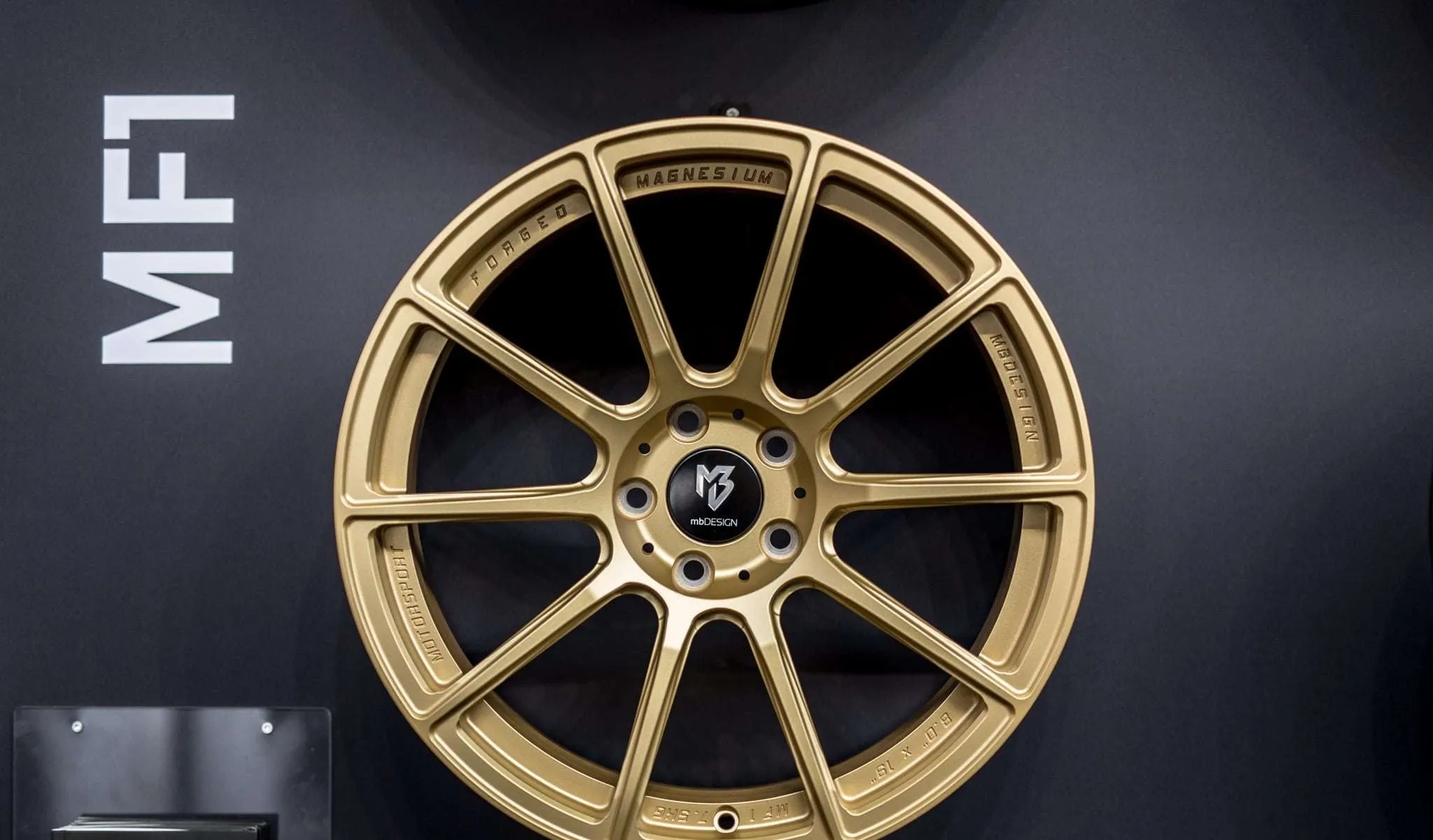
mbDESIGN · Forged Wheels Germany
Forged
Magnesium
Wheels.
KBA road approval 2018.
Developed by mbDESIGN. Forged from AZ80. Road-approved in Germany in 2018 (KBA) and in continuous road operation since.
mbDESIGN · Forged Wheels Germany
KBA road approval 2018.
Developed by mbDESIGN. Forged from AZ80. Road-approved in Germany in 2018 (KBA) and in continuous road operation since.
Material
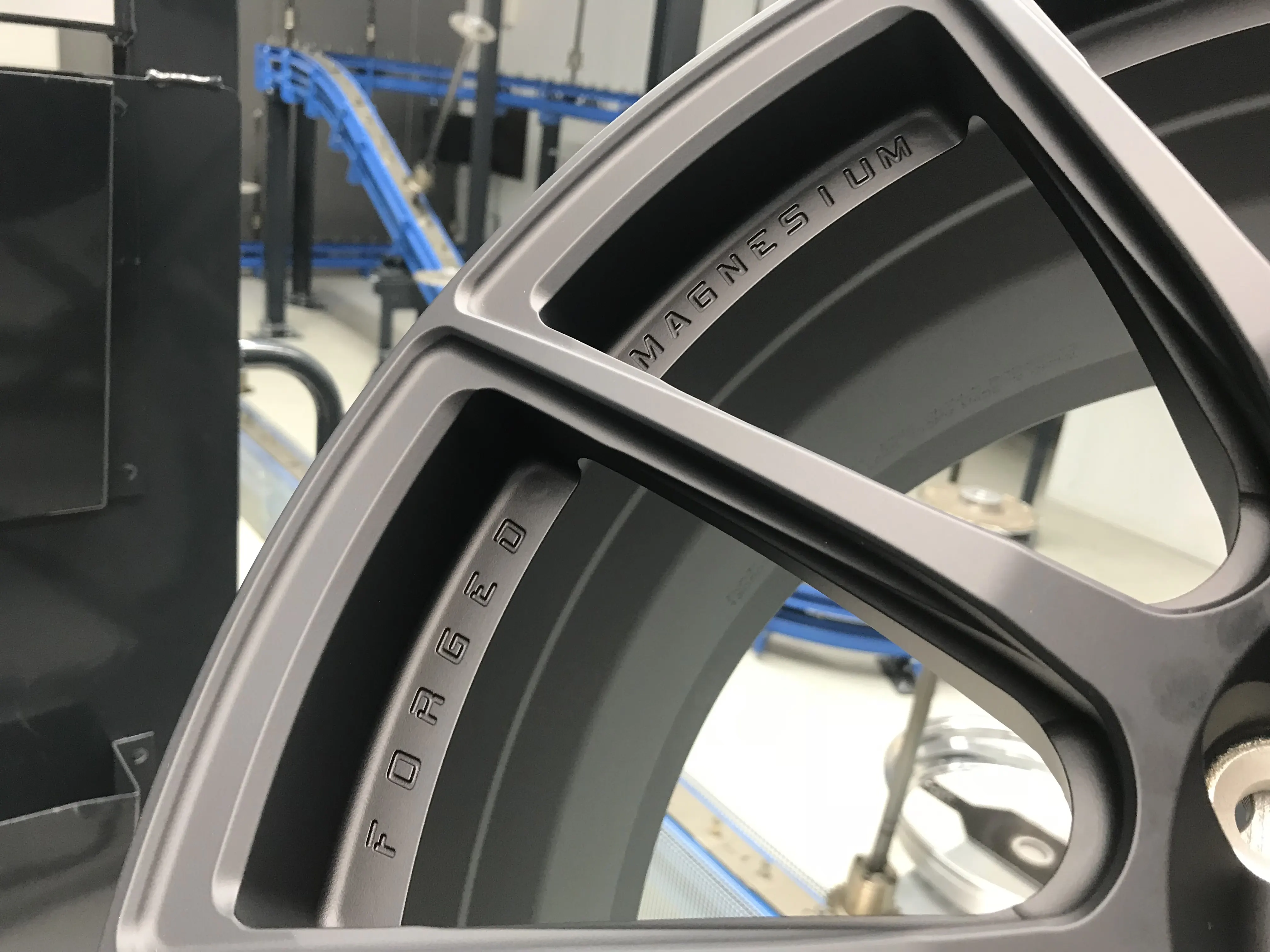
Magnesium is the lightest structural metal used in wheel production. mbDESIGN manufactures forged magnesium wheels from AZ80 – a wrought alloy with around eight percent aluminium that can be precipitation-hardened while remaining forgeable.
The Formula 1 technical regulations prescribe magnesium grades AZ70 or AZ80 for wheels. The same alloy class works in the road-approved mbDESIGN program.
Weight
On the finished wheel, the weight reduction against comparable forged aluminium wheels is 20 to 30 percent – secured by design, not calculated from density alone. Stiffness-critical sections of a magnesium wheel are deliberately sized up.
Wheel weight is unsprung, rotating mass. It acts twice: on wheel control and on rotational acceleration. Less wheel weight sharpens the response of suspension and steering.
Strength
Forging compacts the microstructure under high pressure: pore-free, fine-grained, directional. Compared with cast magnesium, tensile strength roughly doubles; elongation and fatigue strength rise significantly. Casting pores as initiation points for fatigue cracks are eliminated.
Production
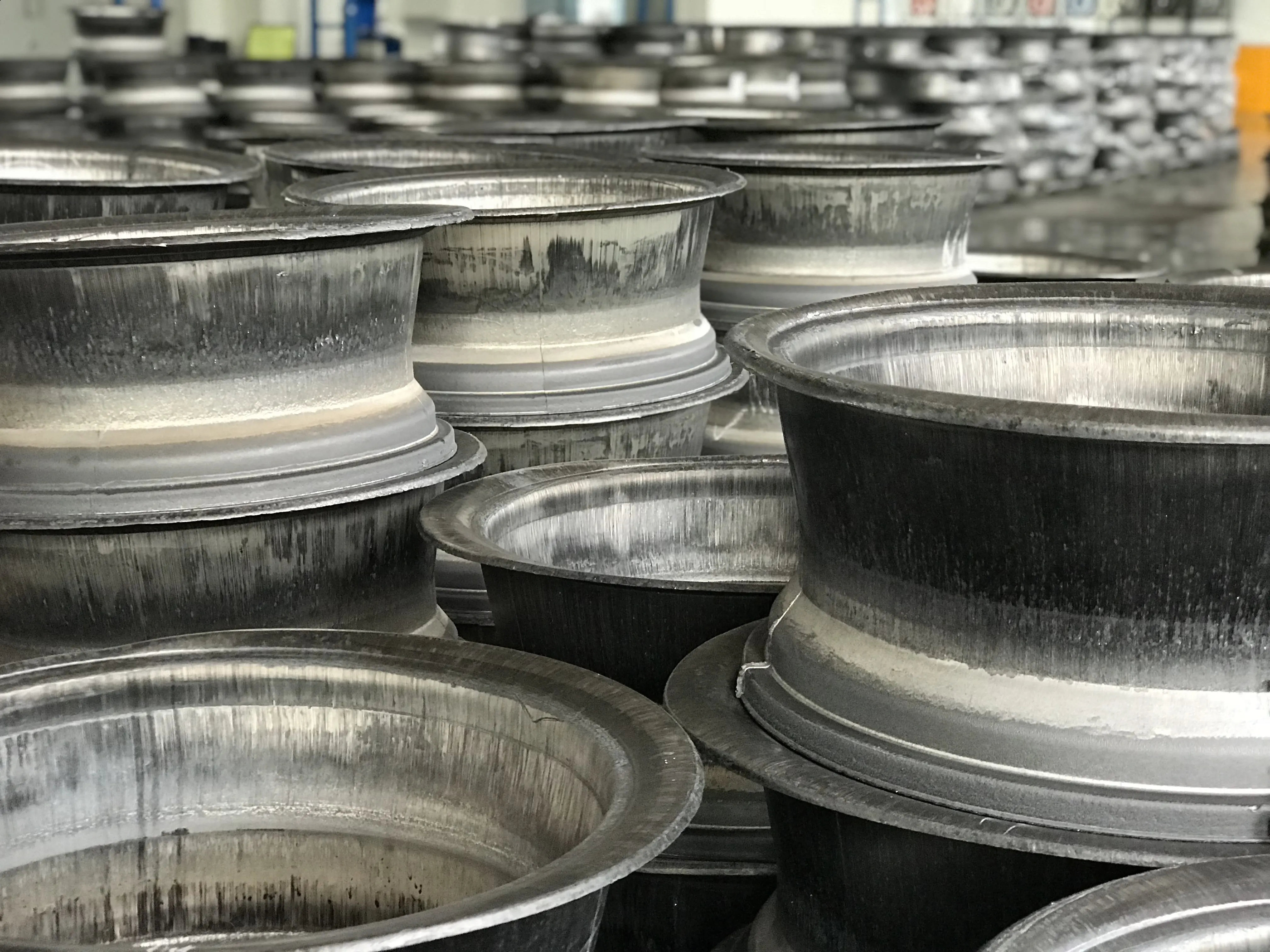
The AZ80 blank is formed under high pressure. The grain follows the wheel geometry; pores are closed.
Final contour, fitment dimensions and weight optimisation are machined.
The surface system of the program has been documented in road operation since 2018.
Development, design and testing: mbDESIGN, Gelnhausen, Germany. Forging at a qualified external production partner.
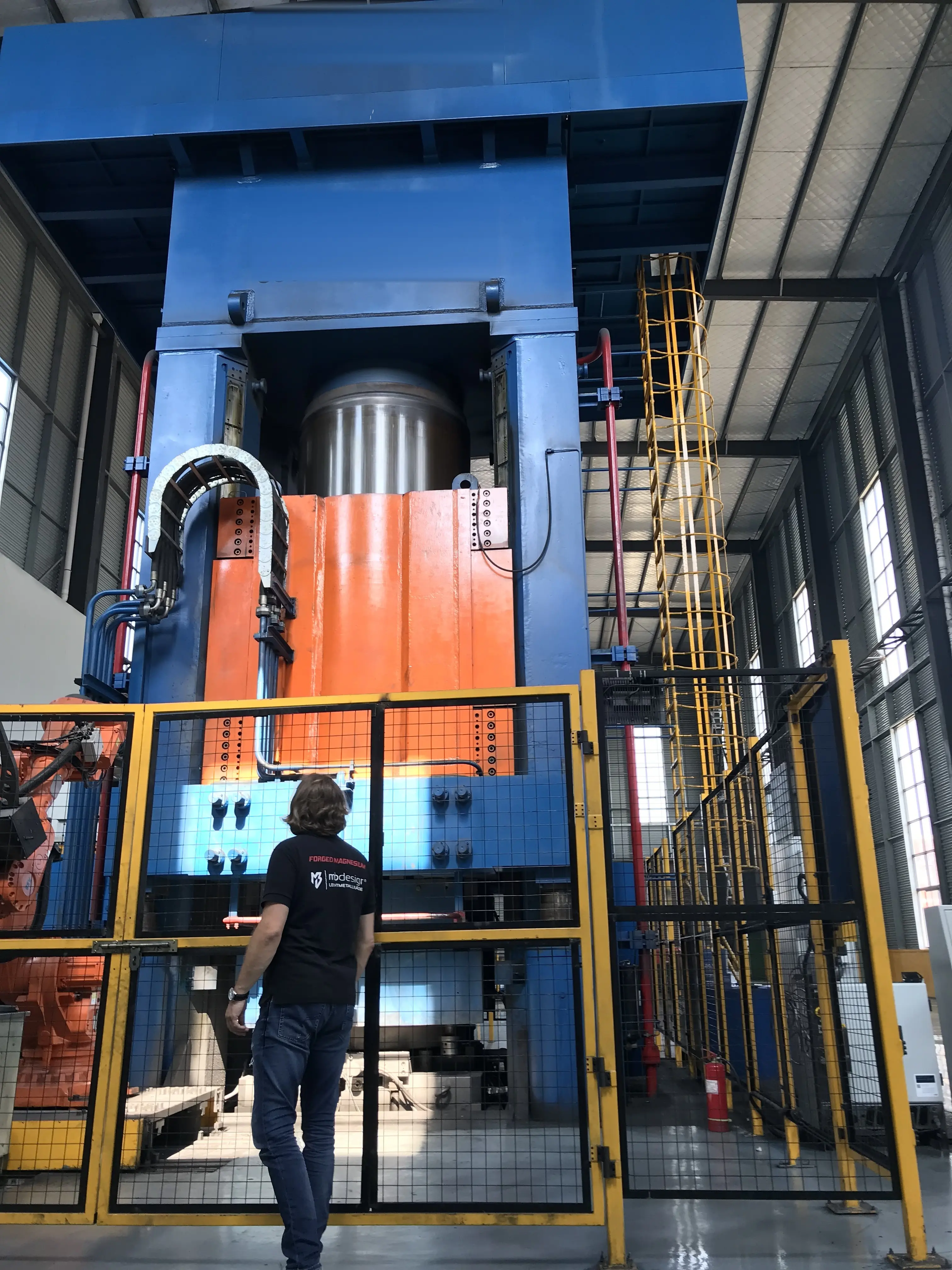
Die forging · forming of the AZ80 blank
Material comparison
Magnesium does not replace aluminium. It is the option when wheel weight is the design target.
| Property | Magnesium AZ80 | Aluminium AL 6061-T6 |
|---|---|---|
| Density | 1.80 g/cm³ | 2.70 g/cm³ |
| Weight on the finished wheel | 20–30 % lower | reference |
| Tensile strength, forged | 345–380 MPa | 330–365 MPa |
| Specific stiffness | nearly identical | nearly identical |
| Thermal conductivity | approx. 77 W/mK | approx. 167 W/mK – aluminium conducts better |
| Application profile | weight-critical applications | universal |
Both materials are engineered and tested to the same standards at mbDESIGN.
Approval
Road-approved wheels pass the same test procedures regardless of material – including rotating bending, rolling and impact testing. The forged mbDESIGN magnesium wheel passed these tests and was approved for road use by the German Federal Motor Transport Authority (KBA) in 2018. The approval does not expire.
Solid magnesium ignites only at temperatures near its melting point of around 650 °C – a range a wheel does not reach in operation. Fire protection is a machining topic, for chips and dust in production, not for the component.
Program
In 2018, the German Federal Motor Transport Authority (KBA) approved the forged mbDESIGN magnesium wheel for road use. It has been in continuous operation since.
Development, testing and German road approval (KBA) of the mbDESIGN forged magnesium wheel. The MF1 and MF2 wheel designs were established within the program.
Corrosion behaviour, coating durability and fatigue performance are documented under real road conditions.
Forged magnesium is part of the mbDESIGN engineering portfolio: development programs from concept and prototyping to pre-series – and where required, into series production.
Fields of use
Lower wheel weight directly benefits range, ride comfort and driving dynamics in electric vehicles.
Weight reduction at high stiffness requirements. Forged magnesium wheels are used where rotating mass is a performance factor.
Small-series and special vehicles with weight targets beyond aluminium wheels – engineered and finished to manufaktur standards.
Forged magnesium wheels are used in series production: cars such as the Porsche 918 Spyder with the Weissach package, the 911 GT2 RS and GT3 RS with the Weissach package or the Lamborghini Huracán STO run them ex works or as a factory option. In motorsport the material has been established for decades – from the Porsche 917 to today’s Formula 1, whose regulations prescribe forged magnesium for wheels.
Gallery
FAQ
Yes. In 2018 mbDESIGN obtained approval from the German Federal Motor Transport Authority (KBA) for a forged magnesium wheel. The wheels have been in road use since.
Wheel weight depends on dimension and offset. In the mbDESIGN program, an 8.0J × 19″ wheel weighs 7.15 kg at a load rating of 580 kg; a 7.5J × 18″ wheel weighs 6.2 kg at a wheel load of 620 kg.
Solid magnesium wheels ignite only at temperatures near the melting point of around 650 °C – a range not reached in driving. The fire risk concerns chips and dust in production, not the finished wheel.
Forging produces a pore-free, fine-grained microstructure. The tensile strength of AZ80 rises from around 168 MPa as-cast to 345–380 MPa forged – with significantly higher elongation and fatigue strength.
20 to 30 percent on the finished wheel. The raw density advantage of the material is one third; part of it is invested in stiffness-appropriate sections.
Magnesium requires an effective surface protection system. The protection concept of the mbDESIGN program has been documented in real road operation since 2018.
Technically, the rim is only the outer ring that carries the tire. The complete component – rim, disc and hub connection – is the wheel. In everyday language, “rim” often stands for the whole wheel; mbDESIGN uses the technically correct term.
The program is operated by mbDESIGN GmbH & Co. KG, a German wheel manufacturer based in Gelnhausen, certified to ISO 9001:2015 and ISO 14001:2015.
mbDESIGN
mbDESIGN GmbH & Co. KG develops and manufactures forged wheels in Gelnhausen, Germany – for premium OEMs, the tire industry and small-series manufacturers. The magnesium program is part of three decades of forging and machining expertise.
mb-design.deContact
Questions on the forged magnesium program are answered by the mbDESIGN engineering team.
Open contact forminfo@mb-design.de +49 6051 91500